
The RESTORE Method
A clear path from received word to faithful response.
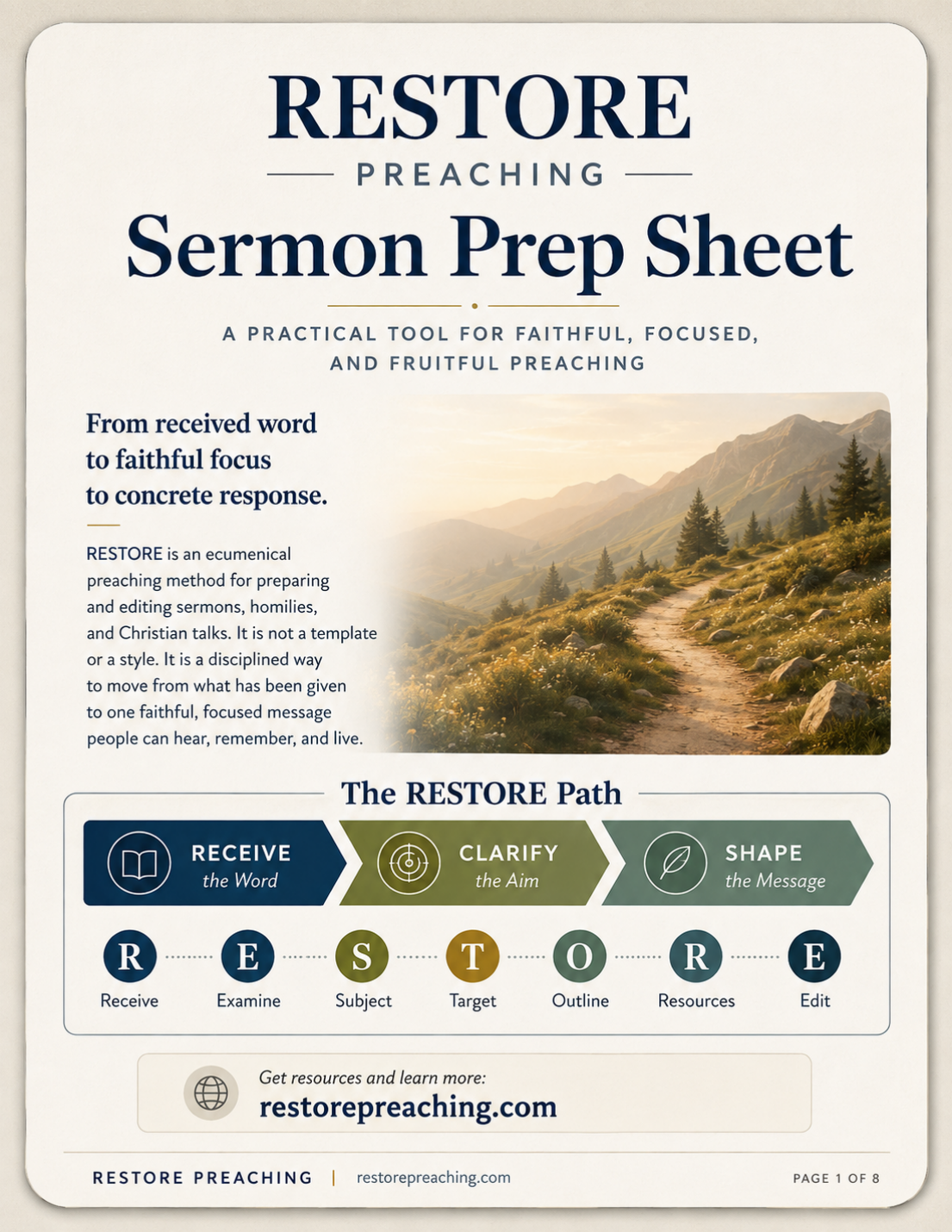
RESTORE is a preparation and editing approach that helps preachers move from what has been given to preach toward a faithful, focused sermon ready to be heard.
What RESTORE is, and what it is not.
RESTORE is a preaching approach. It is not a sermon template, a preaching style, a sermon-grading system, a substitute for prayer or exegesis, or a formula for emotional manipulation. It constrains structure, not voice.
Preparation order is not delivery order. A RESTORE homily can still sound like a homily. A RESTORE sermon can still be narrative, expository, liturgical, inductive, thematic, teaching-oriented, or something else appropriate to its pulpit and tradition.
Receive the Word. Clarify the Aim. Shape the Message.
RECEIVE THE WORD
Receive + Examine
A received text or focus, initial discernment, textual guardrails, and pastoral awareness.
CLARIFY THE AIM
Subject + Target
A narrowed theme, a Target sentence, and a named Tension.
SHAPE THE MESSAGE
Outline + Resources + Edit
A coherent listener journey, supporting Resources, disciplined witness, and revision for fidelity, focus, movement, and response.
A method you can actually work through.
Receive
Discern what has been given to preach. Begin not with “What do I feel like saying?” but “What is being entrusted to me?” Sit with the text, readings, topic, or pastoral burden. Notice what seems alive, difficult, consoling, disruptive, or timely, and ask why this word may matter for this congregation now.
Examine
Engage the text and the hearers with rigor. RESTORE asks two parallel questions: What does this text actually say? Who will be sitting in front of me when I say it? Examine genre, context, movement, key claims, and theological weight, while also attending to the real people who will hear the message.
Subject
Name the broad subject and narrow it to a theme. The Subject gives the sermon a field. The Theme gives it a lane. “Prayer” is broad. “Praying when God seems silent” has begun to find its center.
Target & Tension
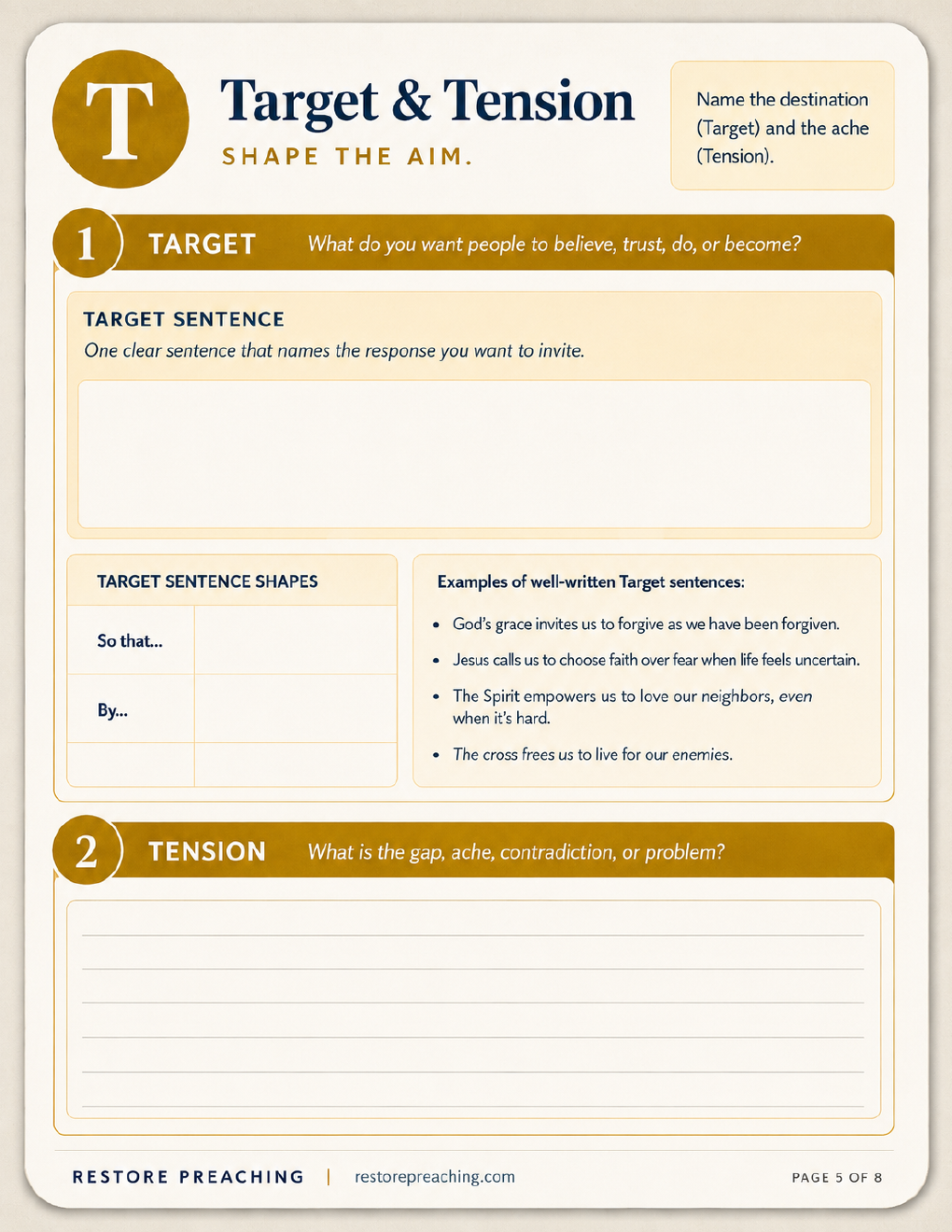
The heart of RESTORE. The Target names what the sermon is meant to accomplish in the hearer. The Tension names the real ache, contradiction, question, or struggle that makes the Target matter. Some tensions are resolved. Others are reframed, illuminated, endured, or inhabited differently through faith. A Target without Tension risks answering a question no one is asking. A Tension without Target creates recognition without a faithful way forward.
RESTORE normally asks the preacher to choose one primary type: persuasive or enabling. Does the hearer need help seeing why, or help knowing how? A Target may be numbered when a defined set genuinely serves the sermon, or it may be a journey Target that names a precise destination without imposing an artificial count.
Outline
Design the listener’s journey from Tension to Target. The Outline is more than a list of points. It is the sequence of movements by which the hearer encounters the tension, follows the word, sees the tension differently, and arrives at the response named in the Target.
RESTORE does not require one delivery structure. It does require movement. Ask of every movement: Why does this come next?
Resources
Choose explanation, examples, stories, images, evidence, quotations, humor, cross-references, and personal witness according to the job the listener journey needs done. Resources are not decorations. They are servants of the journey.
A useful test: “This is here because it helps the listener ________.” If you cannot name the work a Resource is doing, it probably does not belong.
Edit
Test and repair the actual sermon for fidelity, focus, movement, and landing. Drafting introduces drift. Good material grows. Stories get bigger. The sermon reaches its destination and keeps going. Edit asks: Did the sermon we actually prepared faithfully become the sermon we intended to preach?
The four editing actions are simple: Cut. Clarify. Move. Strengthen.
The thinking underneath the method.
Receive before shaping.
The preacher begins with receptivity, not self-expression.
Hear text and people.
Text without people can become academic. People without text can become therapeutic.
One sermon, one aim.
Focus is an act of pastoral mercy because it helps the hearer receive and remember.
Name real Tension.
The tension is recognized, not manufactured for rhetorical effect.
Application is the aim.
The sermon is moving toward a change in belief, action, trust, commitment, repentance, practice, or imagination.
The preacher is a witness.
Not the hero. Not the center. A person in whom the word has done, and is doing, its work.
What a RESTORE sermon should feel like.
Put the method to work this week.
The free RESTORE Sermon Prep Sheet walks you through each step so you can use RESTORE in your next preparation session.